
Ask a site manager what hose they need and the answer is usually just “air and water”. Ask the buyer who has to fill the requisition and it quickly gets more specific: air for what tool, off what compressor, over what distance? Water for supply, for suction or for discharge? Those two words cover the bulk of the hose a construction business gets through in a year, and most of the early failures, wasted coils and wrong deliveries come from treating them as one line each.
This is the selection-basics guide: how to match an air line to the compressor and the tools on the end of it, how to split water work into the three jobs it really is, and what a contractor or plant hire depot should hold so that the right line is on the van. If you need the wider picture of dewatering, suction and extraction, start with our construction & groundworks guide; if your lines are wearing out on the ground, our abrasion-resistant hose guide covers covers and constructions in detail.
Compressed Air: Start From the Compressor
An air line is only as good as its weakest rating. The number that matters is the maximum output of the compressor feeding it — towable site compressors commonly run at around 7 bar — and the hose’s working pressure must sit comfortably above that, never at it. Specify against working pressure, not burst: the burst figure is a safety margin, not a target. Our bore, wall thickness and pressure ratings guide explains how the two relate.
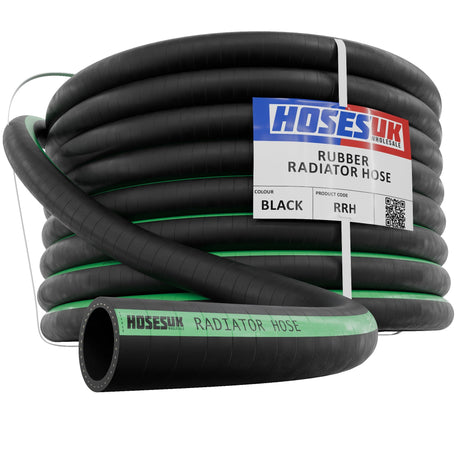
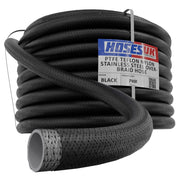
For most site air the default is textile-braided rubber. Our Rubber Air Line Hose runs from 6mm to 19mm bore in 60m coils, is rated up to 20 bar depending on size, and carries a cover built to resist abrasion, weathering and oil mist from the compressor. Rubber stays flexible in the cold and tolerates being dragged across a plot far better than a PVC line, which is why it is the standard for breakers, tampers, needle guns and blow-down.
Water: It Is Three Jobs, Not One
Water is where the wrong hose costs most, because the three common site duties need completely different constructions. Our water hose range and PVC air & water hose range are organised around exactly this split:
The commonest mistake we see on requisitions is a single “water hose” line expected to do all three. Layflat on a pump inlet flattens the moment the pump starts; a light unreinforced line on a pressurised supply swells and splits. Spell out the duty on the order and the specification almost writes itself.
The Core Lines at a Glance
These are the stocked lines from our industrial hose range that cover the bulk of construction air and water work, with the published figures:
| Rubber Air Line Hose | 6–19mm bore, 60m coils. Textile braid. Up to 20 bar (size dependent), −20°C to +85°C. Site compressed air. |
| Rubber Multi Purpose Hose | 5–25mm bore, 50m or 100m coils. NBR/SBR tube, textile braid. Up to 20 bar (varies by size), −20°C to +120°C. Air, water and light oils off one line. |
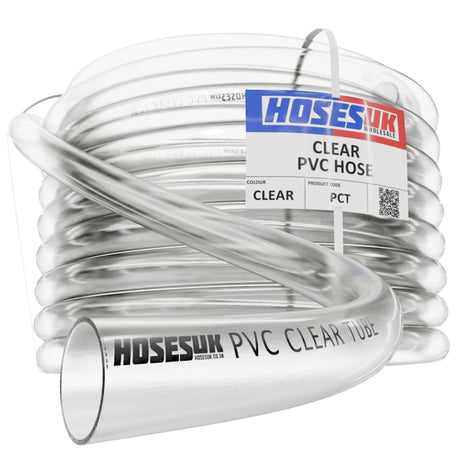
| PVC Clear Braided Hose | 5×9mm to 51×58mm, 30m coils. Polyester braid, 3:1 safety factor, −10°C to +65°C. Water supply and light air. |
| Coloured PVC Braided Hose | Polyester-braided PVC in a choice of colours — useful for telling air, potable and dirty water lines apart on a busy site. |
| PVC Wire Reinforced Hose | 10×16mm to 51×65mm, 50m or 100m coils. Galvanised steel helix, rated to −0.85 bar vacuum, 3:1 safety factor. Pump suction and delivery. |
| PVC Layflat Hose | 25–103mm bore, 100m coils. Polyester braid, up to 4 bar (varies by size), −10°C to +70°C, blue or yellow. Discharge and dewatering. |
Selecting a Line in Five Questions
Stocking for Contractors and Plant Hire Depots
For a contractor running several sites, or a hire depot sending lines out with compressors and pumps, the most efficient pattern is to buy full coils of a few core bores and cut to length in the yard. Full coils keep the cost per metre down and give you continuous runs instead of joined offcuts, which are where most air and water leaks start. Hold the air line and braided supply hose in the two or three bores your kit actually uses, a coil of wire-reinforced suction hose per pump size, and layflat in the discharge diameters your pumps take.
With the colder months coming, it is worth checking site lines now rather than in January: PVC hose rated to −10°C becomes stiff as it approaches that limit, and water left standing in a line can freeze and split it. Drain supply lines at the end of the day and keep a spare coil of the core bore in the cabin.
Hoses UK is a trade-only wholesaler. The £500 minimum (ex VAT) applies to the whole order, so air line, water hose, layflat, clips and joiners can all go on one consignment. Every order is settled before dispatch by pro-forma, card or PayPal — no credit checks, no application — which is part of how we keep pricing sharp and stock deep. Stocked lines are dispatched within 1–2 working days of cleared payment, with free standard delivery to mainland UK on orders over £500, an Express next-day option for a £20 surcharge, and collection from Mirfield by arrangement.
Open a trade account, take £25 off your first order, and put the right air and water lines on every van.