
Three numbers decide whether a hose does its job: the bore, the wall and the pressure rating. Most buying errors are not exotic material failures – they are one of those three read wrongly, or read in isolation from the other two.
This is a spec guide rather than a sales page: what each number actually means, which one is doing the work, and the sums worth doing before a bulk order goes in. Written for the person signing off the purchase order.
The Anatomy of a Hose Spec
Every listing across the hose range carries the same set of figures. Here is what each one is telling you, and what it is not:
| Internal diameter (I.D.) | The bore. It is the dimension the hose is sold and specified by, because it is what the spigot, stub or tail has to fit into and what governs flow. Every size on the site is quoted I.D. first. |
| Outside diameter (O.D.) | What the clamp has to close on and what has to clear the loom, bracket or trench next to it. Ignore it and you order a hose that fits the stub but not the space, or a clip that runs out of band. |
| Wall thickness | Rarely printed as its own figure — it is the difference between the two diameters, halved. It drives crush resistance, bend behaviour and how much abuse the cover takes, but on its own it does not set the pressure rating. |
| Working pressure | The continuous, everyday rating: what the hose is designed to see all day at ambient temperature. This is the only pressure figure you should be specifying against. |
| Burst pressure | The destructive test figure. It is not a headroom allowance and it is not a rating — it exists to prove the safety factor, and nothing more. |
| Safety factor | The ratio between the two. On the PVC braided and wire-reinforced ranges it is 3:1, so a hose rated 10 bar working is proved to 30 bar burst. A quoted burst pressure with no stated ratio tells you very little. |
| Vacuum rating | A separate number entirely, and one a pressure rating never covers. The PVC wire reinforced range is rated to –0.85 bar because a steel helix holds the bore open; an unreinforced hose on the same duty simply flattens. |
| Temperature range | The stated range is the survival envelope, not the range across which the pressure rating holds. Pressure capability falls as temperature climbs — always read the two figures together. |
Wall Thickness: The Number Nobody Prints
Wall thickness is almost never given as its own figure, which is why buyers skip past it. It is sitting in the size code: subtract the bore from the outside diameter and halve it. A 13 mm × 22 mm hose has a 4.5 mm wall. That is a ten-second sum that tells you a great deal about how a hose will behave.
| 13 mm × 22 mm silicone radiator hose | 4.5 mm wall — the standard wall across the smaller bores, from 13 mm right up to 48 mm. |
| 51 mm × 62 mm silicone radiator hose | 5.5 mm wall — the range steps up a ply band at 51 mm bore and holds it all the way to 152 mm. |
| 6 mm × 16 mm silicone wire reinforced | 5 mm wall on a 6 mm bore — most of that is structure to carry the steel helix, not fluid-side material. |
| 25 mm × 29 mm PVC unreinforced | 2 mm wall, and light duty only. Thicker in absolute terms than a layflat of the same bore, and rated for far less. |
| 25 mm × 27.5 mm PVC layflat | 1.25 mm wall carrying up to 4 bar, because a braided polyester yarn is doing the work rather than the wall. |
| 51 mm × 65 mm PVC wire reinforced | 7 mm wall — the thickest on the list, and it is there for crush and vacuum resistance rather than pressure. |
Two things fall out of that table. First, a well-built range steps its wall up in bands as bore increases rather than scaling it smoothly – the silicone hose range runs a 4.5 mm wall to 48 mm bore and 5.5 mm from 51 mm up. Second, and more usefully: wall thickness and pressure rating are not the same conversation.
What Actually Carries the Pressure
The wall resists crushing, abrasion and kinking. The reinforcement resists pressure. That is why a 1.25 mm layflat wall handles 4 bar while a 2 mm unreinforced PVC wall of the same bore is a light-duty gravity line. Five constructions cover most of what you will buy:

Working Pressure, Burst Pressure and Bore
Working pressure is the everyday, continuous rating. Burst pressure is a destructive proof figure sitting behind a stated ratio – on the PVC braided and wire-reinforced ranges, 3:1. If a supplier quotes you a burst figure with no ratio attached, you have been given a number rather than a rating.
The other thing worth internalising is that pressure ratings fall as bore rises for the same construction. The hoop load in a hose wall scales with diameter, so a 51 mm bore sees far more force at a given pressure than a 13 mm one does. That is why the ranges here read “up to 4 bar” or “up to 20 bar, depending on size” rather than publishing a single number: the figure at the small end of a range is not the figure at the large end. On a bulk order, get the rating confirmed for the specific size you are buying.
Temperature works the same way. The stated range — say –40°C to +120°C on EPDM radiator hose — is the survival envelope, not the band across which the bar figure holds. Hot lines de-rate.
Specifying a Hose in Five Steps
Where the Numbers Land Across the Range
For reference when you are speccing, here is the shape of the main stocked ranges. Note how the coil length shifts with the sector each range serves – that is the wholesale buying unit as much as it is the spec.
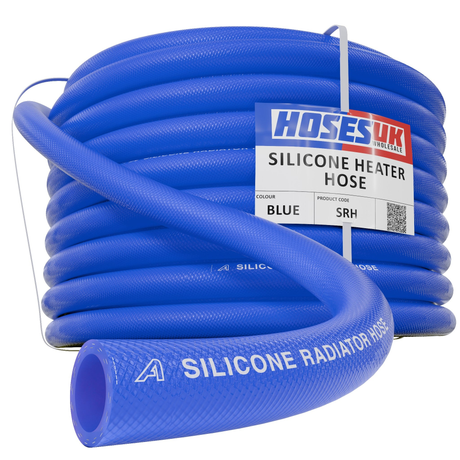
| Silicone radiator hose | 13 mm to 152 mm bore, 4.5 mm or 5.5 mm wall, multi-ply with polyester reinforcement, –50°C to +180°C continuous. Supplied in 1 m lengths. |
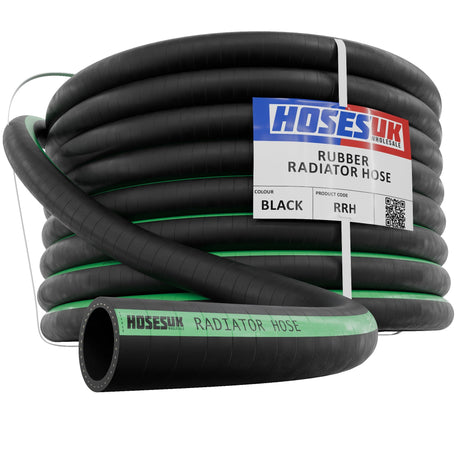
| Rubber radiator hose (EPDM) | 28 mm to 102 mm bore, textile reinforced, up to 10 bar depending on size, –40°C to +120°C with intermittent excursions to +135°C. 1 m and 20 m. |
| Rubber air line | 6 mm to 19 mm bore, textile braid, up to 20 bar depending on size, –20°C to +85°C. 60 m coils. |
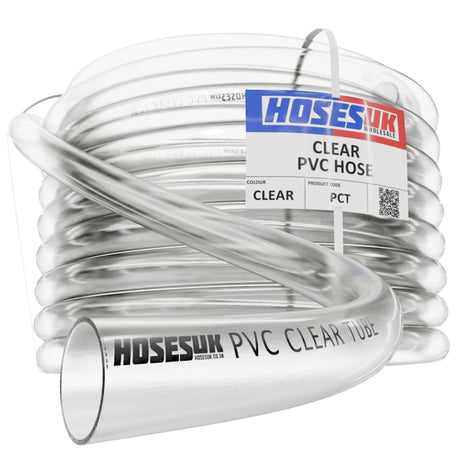
| PVC clear braided | 5 mm to 51 mm bore, polyester braid, 3:1 safety factor, –10°C to +65°C with short-term +70°C. 30 m coils. |
| PVC wire reinforced | 10 mm to 51 mm bore, galvanised helix, vacuum to –0.85 bar, working pressure by size, 3:1 safety factor, certified to BS EN 10324-2005. 50 m and 100 m. |
| PVC layflat | 25 mm to 102 mm bore, braided polyester yarn, up to 4 bar depending on size, –10°C to +70°C. 100 m coils. |
Four Spec Mistakes Worth Designing Out
Bespoke and Own-Brand
If a stocked size does not land where you need it, hose can be made to your own drawing. Bespoke work is quoted per job against a brief giving bore, wall, length and the temperature and pressure duty – which is exactly the four-number spec this guide has been building. The more complete the brief, the faster and sharper the quote. Resellers can take the same route for custom-branded hose carrying their own name.
Get the Spec Right, Then Buy It at Trade
Wholesale rates are published on every product page. Open a trade account, take £25 off your first order, and get stocked lines out on express next-day delivery — or collect the same day from Mirfield.