Two silicone hoses can share a bore, a colour and a price bracket and behave nothing alike once the system is pressurised or put under suction. The difference is what is buried in the wall. Reinforcement is the part of a silicone spec buyers skip most often, and it decides whether a line holds its shape, collapses on the suction side of a pump, or balloons after its first heat cycle.
This guide covers the three terms you will meet on datasheets – ply, knit and wire – what each does, which we stock across our silicone hose range, and the published figures on every line. Where the catalogue stops, we say so.
3-ply & 4-ply fabricSteel wire helixPressure published per bore3:1 safety factor£500 min order (ex VAT)Next-day ex-stock
Three Words on a Datasheet
Ply, knit and wire are not grades of the same thing. Each puts strength into the wall against a different load – and a fourth option, no reinforcement at all, is just as deliberate.
Ply: fabric in the wall
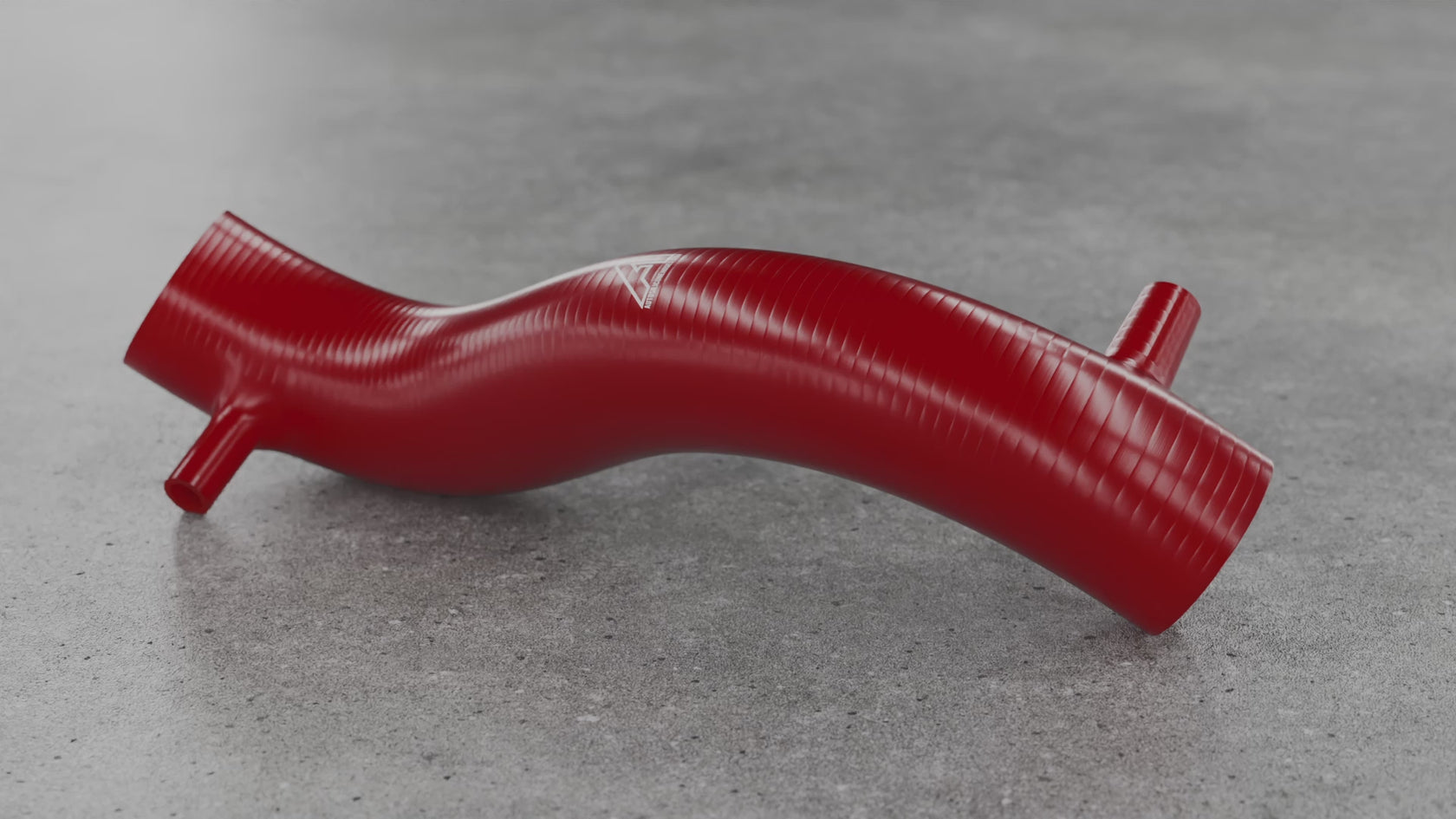
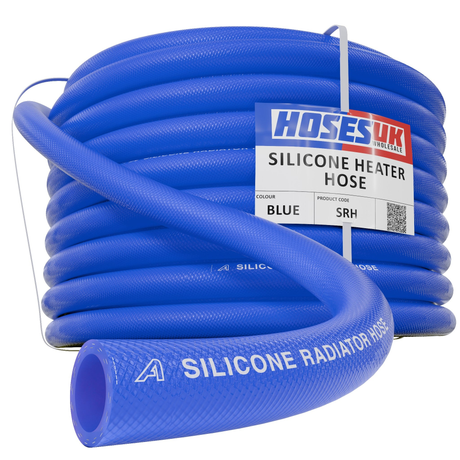
Reinforcing fabric laid up between layers of silicone. On our Radiator Hose, moulded elbows and humps it is polyester braid: 3-ply at a 4.5mm wall up to 48mm bore, 4-ply at a 5.5mm wall from 51mm. Fabric carries internal pressure and stops a hot line ballooning.
Knit: looped yarn over the tube
A continuous looped yarn over the tube rather than separate plies, usually found on small-bore hose where flexibility matters more than pressure. To be straight about it: nothing in our stocked silicone range is specified as knit-reinforced.
Wire: a steel helix
A steel wire spiral moulded into the wall so the bore cannot be pulled flat. Ours pairs it with polyester braid, and its published job is suction, vacuum and low-pressure work – lines where fabric-only hose would collapse.
None: plain silicone
Soft by design, for signal and breather work – boost controllers, MAP sensors. Our vacuum hose datasheet is explicit: reinforcement none, not for pressurised applications. Keep it out of coolant orders.
Illustrative cross-section. Fabric plies (left) sit inside a smooth wall and carry internal pressure; a steel wire helix (right) gives the ridged wall that stops the bore being pulled flat under suction.
What Reinforcement Changes – and What It Doesn't
Think about reinforcement by the load it resists, and the product choice mostly makes itself.
Pressure falls as bore rises
Working pressure drops as bore grows — 10 bar at 6mm down to 4 bar at 63mm on the Radiator Hose. A bigger bore puts more force on the same wall, which is where the ply count steps from 3 to 4.
Vacuum is a different load
Pressure pushes a hose outward, and fabric is strong in tension. Suction pulls it inward, where fabric does little. Resisting collapse needs something stiff in the wall — the helix.
Wire costs you bend
The helix holds the bore round but sets a minimum bend radius: 96mm at 6mm, rising to 288mm at 35mm on our Wire Reinforced Hose. For a tight turn, fit a moulded elbow.
Heat is mostly the compound
Temperature tolerance comes mainly from the silicone, not the reinforcement. Fuel and oil are a compound question too — no ply count makes standard silicone fuel-safe.
The Published Figures, Line by Line
Every figure below is published on the product's own datasheet, so you can size and price an order without ringing round first. Pressures are working figures, with burst alongside where one is published; our silicone datasheets quote a 3:1 safety factor.
Polyester braid – 3-ply, 4.5mm wall to 48mm; 4-ply, 5.5mm wall from 51mm – 6mm to 63mm bore – working 10 bar down to 4 bar, burst 30 bar down to 12 bar – 1m lengths – SAE J20R3
VMQ silicone – 2mm to 10mm bore – 30m coils – not for pressurised applications
Two things stand out. The Radiator Hose and Fuel & Oil Hose publish identical pressures bore for bore – the fluorosilicone lining changes what the hose can carry, not how much pressure it takes. And the glass-fibre ducting carries no pressure rating: it is sold as air ducting, so do not quote it for a pressurised fluid line.
Fabric stops a hose bursting. Wire stops it collapsing. Neither makes it fuel-safe — that is the job of the lining.
Speccing Reinforcement on a Trade Order
Most wrong silicone orders are right on bore and wrong on duty – a fabric hose on a suction line, a vacuum hose on a coolant run. Four checks catch nearly all of it.
1
Name the duty
Pressure, suction, or signal and breather? It decides the reinforcement before bore or colour come into it.
2
Read the figure at your bore
The 10 bar headline on a 6mm line is not the figure on a 51mm one. Pressures are published per size – check yours.
3
Match the medium
Coolant and air go in standard silicone. Fuel, oil and breather vapour go in the fluorosilicone-lined line, specified to SAE J30R6.
4
Buy the format
Radiator, fuel and oil, and wire hose come in 1m lengths; coolant hose in 20m coils; heater hose in 50m; vacuum hose in 30m.
Ordering from Hoses UK
Everything in the table sits in the silicone hoses collection alongside the elbows, reducers, humps and T-pieces. Hoses UK is trade-only, on a £500 minimum order excluding VAT. Every order is pro-forma, settled before dispatch: no credit checks, no application stage – a large part of why the pricing is sharper and the stock deeper. Stocked lines ship next-day, or collect the same day from Mirfield. Custom-branded and bespoke hose is quoted per job.
Open a trade account, take £25 off your first order, and buy reinforced silicone hose at genuine wholesale.
The number of reinforcing fabric layers in the wall. Our Radiator Hose, Fuel and Oil Hose and moulded elbows are 3-ply at a 4.5mm wall up to 48mm bore and 4-ply at a 5.5mm wall from 51mm. Always check the working pressure published for the exact bore you are buying.
Do you stock knit-reinforced silicone hose?
No. Our silicone range is fabric-reinforced with polyester braid, wire-reinforced with a steel helix, or unreinforced for vacuum lines. If a spec calls for knit, send it to the team and you will get a straight answer on whether anything we hold is a sensible match.
When do I need wire-reinforced silicone hose?
When the line can be pulled flat – suction, vacuum, the inlet side of a pump. Ours runs 6mm to 35mm bore in 1m lengths. Allow for its bend radius: 96mm at 6mm, up to 288mm at 35mm.
How do I order, and how quickly can I get it?
Hoses UK is trade-only, with a £500 minimum order excluding VAT. Every order is pro-forma, settled before dispatch — no credit checks, no application. Stocked lines go next-day, or collect same day from Mirfield. New trade customers get £25 off their first order.
Regular priceFromChoose options to view priceex VAT
/
Unavailable
Wholesale Minimum Order Value
Please note that this website is for wholesale and trade customers only. A minimum order value of £500 (ex. VAT) applies to all orders placed through this site.