Site hose is a consumable that behaves like a critical spare. It gets dragged over rebar,
run over by a dumper, left in a trench overnight and coiled wet – and when it fails, the pump stops, the
excavation fills and a crew stands still. For anyone buying for construction and groundworks, the job is
not finding the cheapest metre. It is specifying lines that survive the site, and holding enough of them
that a failure costs minutes instead of days.
This guide covers the four duties a site actually has, the specifications that matter for
each, and how to buy them so your stockholding works as hard as your plant does.
Dewatering & dischargeSuction linesCompressed airDust & fume extractionFull-coil buying£500 min order (ex VAT)
The Four Duties on a Groundworks Site
Almost everything a site needs falls into one of four jobs. Get the duty right and the
rest of the specification follows – get it wrong and no amount of pressure rating will save the hose.
Dewatering & discharge
Trench, excavation and pump-out work. Layflat is the default – it packs down to nothing on the van, deploys in seconds and handles volume rather than pressure.
Suction & transfer
Pulling water or slurry into a pump needs a hose that won't collapse. That means a wire helix, not a braid – rated for vacuum as well as working pressure.
Compressed air
Breakers, tampers and pneumatic tools. Textile-braided rubber airline, rated well above the compressor's output, in coils long enough to reach across a plot.
Extraction & ventilation
Cutting, coring and confined-space work. Anti-static PU ducting moves dust and fume – it is not a pressure line and should never be specified as one.
The full industrial hose range covers all four, and the PVC air & water hose lines are the ones most site buyers
end up standardising on for water.
Site Specifications at a Glance
These are the working figures for the lines we hold in stock for site work. Every one
carries a 3:1 safety factor, so specify against the working pressure – never the burst figure.
| PVC Layflat Hose |
25mm – 102mm bore, 100m coils. Polyester-yarn reinforced, ISO 8029:2007. Working pressure up to 4 bar (varies by size), –10°C to +65°C. Blue or yellow. |
| PVC Wire Reinforced Hose |
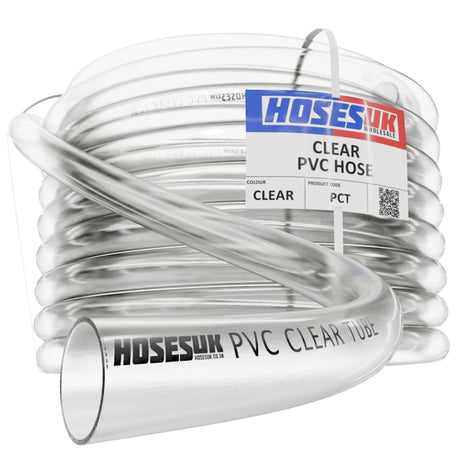
10x16mm – 51x65mm, 50m or 100m coils. Galvanised steel-wire helix, BS EN 10324-2005. Rated to –0.85 bar vacuum, –10°C to +65°C. Clear, so you can see a blockage. |
| Rubber Air Line Hose |
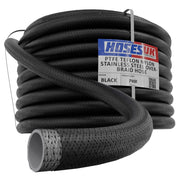
6mm – 19mm bore, 60m coils. High-tensile textile braid, ISO 5774:2016 Type B. Working pressure up to 20 bar depending on size, –20°C to +80°C. |
| Rubber Multi Purpose Hose |
5mm – 25mm bore, 50m or 100m coils. Oil-resistant NBR tube with fabric layers. –20°C to +100°C — air, water, fuel and light oils off one line. |
| Polyurethane PU Ducting |
38mm – 200mm bore, 10m or 20m coils. Copper-plated anti-static steel helix, TRBS2153. –40°C to +90°C. Not for pressurised applications.
|
| PVC Corrugated Hose |
19mm – 51mm bore, 30m or 50m coils. Smooth bore, corrugated wall for a tight bend radius. Light-duty drainage, cable protection and dust collection. |
The two numbers that decide whether a hose survives a site are working pressure and temperature range — at the worst case the site will see, not the average.
Specifying a Line – Step by Step
1
Fix the duty
Suction or discharge? Air or water? Pressurised or extraction? This one answer eliminates most of the catalogue before you look at a single price.
2
Set the bore
Size on flow rate and pump connection, not on what is nearest to hand. Undersized bore costs you pump efficiency for the life of the hose.
3
Check the two ratings
Working pressure and temperature, both at the worst case the site will see. Every line we stock carries a 3:1 safety factor — design to the rating, not to the burst figure.
4
Order the coil length
Round up. A 100m coil that covers the longest run on site is worth more than two 50m coils and a joiner in the middle of a trench.
Buying and Holding Site Hose
The specification is only half of it. How you buy determines whether the right hose is
on the rack at seven in the morning when a pump lets go.
Buy the bore, not the brand
Site crews lose hose. Standardising on three or four bores across the whole site – typically 25mm, 51mm and 102mm on water, 13mm on air — means one spare coil covers everything.
Coils, not off-cuts
Every line here is priced per metre and supplied in full coils. It is the cheapest way to buy and it means the next failure is a five-minute swap, not a two-day wait.
Match the clip to the hose
A 4 bar layflat line held with a mini clip is a callout waiting to happen. Worm-drive for general site work, T-bolt where vibration and pressure are both in play.
Hold for the season, not the job
Groundworks demand spikes with the weather. Dewatering stock bought in March is materially cheaper than dewatering stock bought in the middle of a wet November.
Where the Cold Weather Catches People Out
Most PVC site lines — layflat, wire-reinforced, corrugated — are rated to
–10°C. That is fine for a British winter in use, but PVC stiffens as it approaches the bottom of its
range, and a coil dragged out frozen at first light is far easier to kink or split than the same hose at
midday. Where hose is genuinely working cold, or against machinery heat, the rubber lines earn their place:
multi-purpose rubber runs –20°C to +100°C and airline –20°C to +80°C. It is worth
splitting a winter stock order along those lines rather than buying one hose for all twelve months.
Ordering from Hoses UK
Hoses UK is a trade-only wholesale distributor, so pricing is built for volume rather
than one-off retail. The minimum order is £500 excluding VAT, and every order is
settled before dispatch — there is no credit application to wait on and no credit check to pass, which
is precisely what lets us price sharper and hold deeper. Core lines ship on express next-day
delivery, with same-day collection from our Mirfield warehouse when a site is
already down.
Frequently Asked Questions
What hose should we use for site dewatering?
PVC layflat, in almost every case. It is reinforced with braided polyester yarn to ISO 8029:2007, runs from 25mm to 102mm bore, handles up to 4 bar working pressure depending on size, and lays flat so a 100m coil takes up almost no space on the van. Where the hose sits on the suction side of the pump, switch to wire-reinforced PVC — layflat will collapse under vacuum.
Do we need pressure-rated hose for site air tools?
Yes. Rubber air line hose is built for it: a smooth synthetic rubber bore, high-tensile textile braid and a weather-resistant cover, rated to ISO 5774:2016 Type B with working pressures up to 20 bar depending on bore, over a –20°C to +80°C range. Sizes run 6mm to 19mm in 60m coils. Never run a compressor through unreinforced PVC.
What lengths does site hose come in for trade orders?
Full coils, priced per metre. Layflat is 100m; wire-reinforced PVC is 50m or 100m; airline is 60m; multi-purpose rubber is 50m or 100m; PU ducting is 10m or 20m; corrugated PVC is 30m or 50m. Buying complete coils is what makes the per-metre rate work, and it means a failed run is replaced from your own rack rather than ordered in.
What is the minimum order, and how do we pay?
The minimum order is £500 excluding VAT. Hoses UK is pro-forma: every order is settled before dispatch, so there are no credit checks and no account application to wait on. That is a deliberate choice — it is what funds sharper pricing and deeper stockholding. New trade customers get £25 off their first order.