Unreinforced Fuel & Oil Hose NOW AVAILABLE - Shop Now

Buy Today, Delivery Tomorrow! - Next Day Shipping Available

£500 Minimum Order

NEW CUSTOMER DEAL

£25 Off Your First Order

25OFF

Hose & Ducting for Agriculture: Fuel, Water & Slurry

Hose & Ducting for Agriculture: Fuel, Water & Slurry

Agriculture is unusually hard on hose. A single yard will be running diesel transfer, wash-down, irrigation, a compressor line in the workshop and dust extraction over a grain store – five media, five failure modes, and most of it living outdoors through a British winter. Spec any of it on bore alone and you will be back at the same job next season, usually at harvest, usually in the rain.

This is a buyer's guide rather than a fitter's guide. It is written for dealers, ag engineers, plant and machinery firms and estate workshops who order hose by the coil, and it covers what actually goes where, the specs on the lines we hold, and – just as usefully – where the standard catalogue stops.

100m coils-10°C to +70°C layflat20 bar air lineBS EN 10324-2005£500 min order (ex VAT)Next-day ex-stock

Four Duties, Four Different Hoses

The mistake that costs money is treating “farm hose” as one category. The agricultural hose range splits cleanly into four jobs, and each one has a material answer that is not interchangeable with the others.

Fuel & oil
Gravity-fed and low-pressure diesel transfer runs on unreinforced nitrile, stocked from 3×7mm up to 10×15mm in 100m coils. Where the line sits near heat or carries vapour, the fluorosilicone-lined silicone hose takes over – it is rated -50°C to +180°C and supplied in 1m cut lengths.
Water, irrigation & dewatering
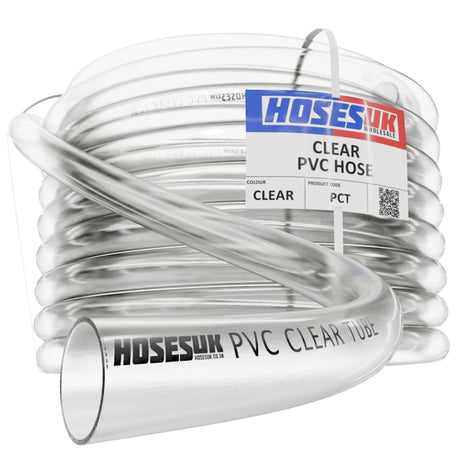
Two different answers. Layflat is the discharge and volume hose – 25mm to 103mm bore, 100m coils, up to 4 bar, rolled flat on the trailer between jobs. Clear wire-reinforced PVC is the suction and delivery hose, rated to -0.85 bar vacuum so it will not collapse on the inlet side of a pump.
Air & workshop lines
Rubber air line covers the compressor side of the yard: 6mm to 19mm bore, 60m coils, up to 20 bar and good from -20°C to +85°C. It is the one line on a farm that is genuinely indoor-spec, so it is also the one most often bought too short.
Dust, chaff & extraction
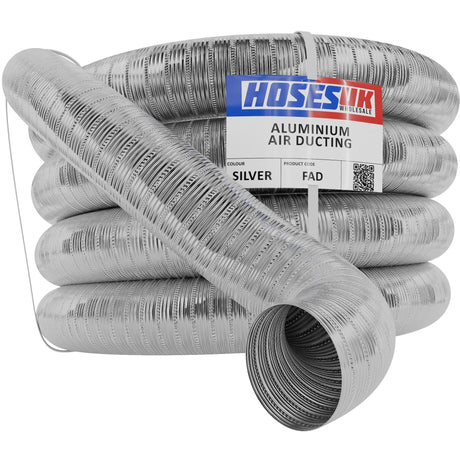
Polyurethane ducting handles grain dust, sawdust and granule conveying at 25mm to 200mm bore, with a copper-coated spring steel helix that recovers after it gets stood on. Aluminium and 2-ply silicone ducting cover the hot-air and engine-bay end.

The Stocked Range at a Glance

Here is the working detail on the lines that do most of the agricultural work, so you can size and price an order without ringing round for a datasheet first. Every figure below is the published spec on the product itself.

PVC Layflat Hose 25mm to 103mm I.D. – 100m coils – up to 4 bar – -10°C to +70°C – blue & yellow
PVC Wire Reinforced Hose 10×16mm to 51×65mm – 50m & 100m coils – vacuum -0.85 bar, 3:1 safety factor – -10°C to +65°C – certified to BS EN 10324-2005
Rubber Multi Purpose Hose 5mm to 25mm I.D. – 50m & 100m coils – up to 20 bar – -20°C to +120°C – NBR/SBR tube, textile braid
Rubber Unreinforced Fuel & Oil 3×7mm to 10×15mm – 100m coils – gravity-feed and low-pressure only – -20°C to +100°C – nitrile
Rubber Air Line Hose 6mm to 19mm I.D. – 60m coils – up to 20 bar – -20°C to +85°C
Silicone Fuel & Oil Hose 6×15mm to 19×28mm – 1m lengths – -50°C to +180°C – fluorosilicone-lined for hydrocarbons
Polyurethane PU Ducting 25mm to 200mm I.D. – 10m & 20m coils – -40°C to +90°C – copper-coated spring steel helix
PVC Corrugated Hose 19mm to 50mm I.D. – 30m & 50m coils – -5°C to +65°C – light-duty suction, drainage and pond work

Two things worth pulling out of that table. First, the clear wire-reinforced PVC is the only stocked line certified to a standard – BS EN 10324-2005 – and the only one with a published vacuum rating, which is why it is the right answer on the inlet side of a pump and layflat is not. Second, the temperature ranges matter more in this sector than most: a hose rated to -5°C is a hose that will be brittle in an open yard in January.

A length of yellow PVC layflat hose lying flat and collapsed next to a length of clear wire-reinforced PVC suction hose holding a round open bore, on a workshop bench
The whole distinction in one shot: layflat (left) collapses flat for discharge and storage, while the steel-wire helix in clear PVC (right) holds the bore open under vacuum — which is why only one of them belongs on the inlet side of a pump.

Where Slurry Sits, and Where It Doesn't

Slurry is the duty that catches buyers out, so it is worth being blunt about it. Nothing in our stocked catalogue is a dedicated slurry hose. Slurry is abrasive and chemically aggressive, tanker and umbilical work is generally done at bores above anything we hold, and clear PVC specced for water transfer will not give you a season on it however well it matches on diameter.

A hose that fails mid-season doesn't cost you the hose — it costs you the day.

What the range does cover is everything around the slurry line: layflat for pump discharge and dirty-water bypass, clear wire-reinforced PVC for suction and delivery on drainage and washdown, and corrugated PVC ducting for low-pressure drainage and pond work. If the duty genuinely is slurry, bring the medium, the bore, the pressure and the fittings to the team before you order. Bespoke hose is quoted per job – and if it is not something we can supply properly, you will be told that too.

Buying for a Season, Not for a Breakdown

Farm buying is seasonal in a way that most trade buying is not. The difference between a good hose order and an expensive one is almost entirely about when the list gets written, not about unit price.

1
Audit at the end of the season, not the start
Walk the yard while the failures are still fresh: what split, what perished, what got cut short and bodged. That list is your order, and it is worth more than any forecast built in February.
2
Group by medium, not by machine
Six machines running diesel need one hose, not six part numbers. Sorting the list by what flows through it collapses a scattered basket into a handful of coils and kills the duplicate lines you are already holding.
3
Round up to the coil
Hose is sold by the coil – 100m of layflat, 60m of air line, 20m of ducting. Buying the coil rather than the measured run is what puts the offcuts on your shelf instead of on someone else's invoice.
4
Close the basket with consumables
Worm drive clips, T-bolt clamps, rubber-lined P clips and aluminium joiners all come in packs of ten, never go out of date, and get used on every job on the bench. They are the safest way to bring an order up to the minimum.

Ducting: The Half of the Order People Forget

Extraction and air movement get bought reactively far more often than hose does, usually the morning something blocks. The ducting range is worth holding a coil of for exactly that reason: polyurethane at 25mm to 200mm bore for grain dust, chaff and granule conveying, aluminium ducting for hot air, and 2-ply silicone for engine-bay and induction work on the machinery side. The PU wall is around 0.4mm and clear, so a blockage is something you can see rather than something you diagnose.

Ordering from Hoses UK

Hoses UK is a trade-only wholesale distributor working on a £500 minimum order, excluding VAT. Every order is pro-forma, settled before dispatch: no credit checks, no application stage, nothing to chase at either end – which is a large part of why the pricing is sharper and the stockholding is deeper. Stocked lines ship express next-day, or you can collect the same day from the Mirfield warehouse if a machine is standing.

Open a trade account, take £25 off your first order, and buy your agricultural hose and ducting at genuine wholesale.
Open a Trade AccountTalk to the TeamBrowse the Range

Frequently Asked Questions

What hose should I stock for on-farm diesel and oil transfer?
For gravity-fed and low-pressure transfer, the unreinforced nitrile fuel and oil hose is the workhorse – 3×7mm to 10×15mm bore, 100m coils, rated -20°C to +100°C. Where the run sits close to heat or carries fuel vapour, the fluorosilicone-lined silicone hose is the better call at -50°C to +180°C. Match on internal diameter and working pressure, not on what the old hose looked like.
Do you supply hose for slurry?
Not as a dedicated stocked line, and we would rather say that than sell you the wrong hose. Slurry is abrasive and chemically aggressive, and tanker and umbilical work is usually done at bores well above what we hold. What the stocked range does cover is the water side around it: layflat for pump discharge and dirty-water bypass, clear wire-reinforced PVC for suction and delivery, and corrugated PVC for low-pressure drainage. If the duty is genuinely slurry, come to the team with the medium, the bore, the pressure and the fittings and you will get a straight answer on whether we can do it properly.
What coil lengths does the agricultural range come in?
Layflat is 100m. Clear wire-reinforced PVC is 50m or 100m depending on bore. Rubber air line is 60m, unreinforced nitrile fuel and oil hose is 100m, multi-purpose rubber is 50m or 100m, PU ducting is 10m or 20m and corrugated PVC is 30m or 50m. Silicone fuel and oil hose is the exception, supplied in 1m lengths. Buying whole coils is what makes wholesale pricing work.
How do I order, and how quickly can I get it?
Hoses UK is trade-only, with a £500 minimum order excluding VAT. Every order is pro-forma, settled before dispatch — no credit checks, no application to fill in, and sharper pricing and deeper stock as a result. Stocked lines go out on express next-day delivery, or you can collect the same day from Mirfield. New trade customers get £25 off their first order.