
A hose failure almost never costs you the hose. On a 13-tonne excavator with a week of groundworks booked, or a tipper that has to be on site at seven, the part is the cheapest line on the job card by a distance. What it costs is a machine standing still – and that clock starts the moment an operator reports it, not the moment a fitter picks up a spanner.
This guide is written for the people who plan that work: fleet engineers, plant managers, workshop controllers and the distributors who supply them. It is about where the hours leak out of a hose replacement and how to design them out. It is deliberately not about how long a hose lasts — because that is the one number nobody can give you honestly.
Why We Won’t Quote You a Replacement Interval
It is a fair question and it deserves a straight answer: any mileage or hours figure we published would be a guess dressed up as data. Heat cycling, vibration, fluid chemistry and how close a line runs to a turbo all pull service life in different directions, and a gritter working winter nights has nothing in common with a hire-fleet excavator on demolition. What we publish instead is what we can evidence — bore, wall thickness, ply, working and bursting pressure and minimum bend radius, per size, on every product page. Condition-based inspection against a shelf stocked to the right spec is the only approach that survives a mixed fleet.
Where the Downtime Hours Actually Go
Time the next unplanned hose change end to end and split it into these five blocks. Almost none of the total is spanner time, which is exactly why a faster fitter does not fix it.
Two of those five – identifying the part and sourcing it – are pure information problems, and they are the two you can shorten before anything breaks. The old hose off the machine is your specification: bore, length, bend and clamp positions all come off it, and once they are written down nobody has to work them out again.

Planned, Opportunistic or Unplanned
Every hose change lands in one of three buckets and the cost gap between them is enormous. A planned change happens in a service slot you had already booked — the marginal cost is the part and a few minutes. An opportunistic change happens while the machine is down for something else and the access work is already done; if the cooling pack is off for a radiator, the hoses behind it are close to free labour. An unplanned change strands a machine and carries the recovery, the idle crew and the rescheduled work on top of the part. The whole discipline is shifting work out of that third bucket.
Designing the Hours Out
Spec the Replacement So It Stays Fixed
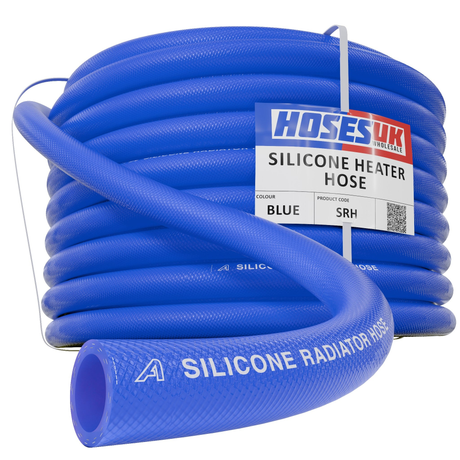
The second half of cutting downtime is making sure the repair holds, because a replacement that fails again in a fortnight has cost you two downtime events instead of one. Every size across our silicone hose range and the wider automotive hose range publishes its own datasheet table, and these are the figures worth reading before you order rather than after.
| Bore vs working pressure | Not a constant, and it catches people out. Our silicone radiator hose is published at 10 Bar working / 30 Bar bursting at 6mm ID, 6.5 Bar / 19.5 Bar at 19mm, and 5 Bar / 15 Bar at 38mm. A bigger bore is a lower-pressure hose, not a stronger one. |
| Number of ply | 3-ply through the 13–32mm bores on our continuous silicone coolant hose, stepping to 4-ply at 51mm. The count is printed in the datasheet table on each product page. |
| Minimum bend radius | Published per size — on silicone heater hose it runs from 70mm at 6mm ID up to 192mm at 25mm ID. Route a replacement tighter than that and it will kink, collapse or split at the bend. |
| Liner material and spec | Fuel and oil lines carry a fluorosilicone liner to SAE J30R6; coolant, radiator and heater lines are silicone to SAE J20R3. Put a coolant-grade liner on a fuel return and it will swell. |
| Reinforcement | Polyester braid on radiator and heater hose, multi-fabric cord layers on continuous coolant hose, and braid plus a steel wire helix where the line must resist collapse under suction. |
| Coil and cut length | Continuous silicone coolant hose lands on 20-metre coils (5 metres at 51mm), heater hose on 50-metre coils. Whole coils decide your order quantity, not your ideal number. |
| Temperature range | Ratings differ by grade and by hose, so take them from the datasheet table on the specific product page rather than from one headline figure quoted across the range. |
The pressure column is the one that surprises people most often. Working pressure falls as bore rises, so a fitter who grabs a larger hose because it “looks heavier duty” may quietly be fitting a lower-rated line. Bend radius is the other common cause of a repeat failure: a hose routed tighter than its published radius will kink or collapse whatever else it is rated for.
What Your Supplier Can Take Off the Clock
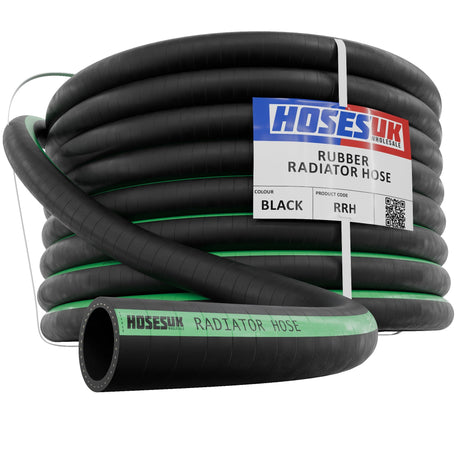
There is a limit to what a distributor can do about downtime and it is worth being clear where it sits. We cannot make a bespoke build appear overnight and we cannot tell you when your hoses will fail. What we can do is keep the sourcing block short: a deep core range of silicone, rubber, PVC and PTFE hose held in stock alongside the clips, clamps and couplers that go with it, so one order covers the job instead of three suppliers and three lead times. In practice that is express next-day delivery on stocked lines and same-day collection from the Mirfield warehouse when tomorrow is not soon enough. Bespoke and custom-branded hose is made to order and needs a longer runway, so it belongs in your planning, not in your breakdown cover.
On payment we keep it simple: every order is settled before dispatch. Hoses UK is pro-forma — no credit application to fill in, no credit check to pass and no account limit to work around before you can buy. That is a deliberate choice, and it is what lets us hold deeper stock and price sharper than we otherwise could. The trade minimum is £500 excluding VAT per order.
Get Set Up Before the Next Failure
Open a trade account, get £25 off your first order, and stock the bores your fleet actually runs – before the next machine goes down.